Fintech startup DPDzero raises $7 million in funding round led by GMO Venture Partners

DPDzero, a Bengaluru-based fintech startup specializing in AI-driven debt collection, has secured $7 million in funding led by GMO Venture Partners. The company intends to utilise the capital to expand its operations by hiring field collection agents, starting in Bengaluru, to ensure ethical collection practices.

Fintech startupDPDzero has raised $7 million in a funding round led by GMO Venture Partners, a Japan-based, fintech-focused venture capital firm. The round also saw participation from SMBC Asia, and Blume Ventures, which doubled down on their investments from the previous round, along with others.

The company plans to use the fresh funds to hire its own field collection agents.

Bengaluru-based DPDzero helps fintechs, banks, non-banking financial companies (NBFCs), and micro-finance institutions (MFIs) in debt collection through artificial intelligence (AI) and human agents. The debt collection company currently partners with various banks and NBFCs, including RBL Bank, IndusInd Bank, L&T Finance and Manappuram Finance.

“What we are also going to do with our new capital-raise, is to build our own field agent network, so that we can bring in the missing ethical collection practice. We want to take care of end-to-end collections for all banks and all NBFCs in the country,” founder Ananth Shroff told ET. DPDzero was set up by Shroff and Ranjith Ramchandra in 2022.

The fintech company plans to start with field collection agents in Bengaluru. In the coming years, DPDzero said it would also use field agents in states such as Maharashtra and Uttar Pradesh, as they top the lending charts.

The company has so far raised $4.7 million from investors such as Better Capital, Anmol Maini Ventures, India Quotient, and so on, according to Tracxn.

DPDzero, which currently processes collections of unsecured borrowings and personal loans, said it plans to also try collections against credit card lending. It has handled collections from 1 crore borrowers so far and is currently doing the same with 18 lakh borrowers, on a monthly basis.

“Over the past decade, we have been deeply committed to India’s fintech ecosystem. As the credit landscape matures, collections remain its most under-served frontier… We are proud to back the founders as they reimagine collections for India,” said Ryu Muramatsu, a founding partner of GMO Ventures Partners.


Get car parts faster than pizza? Inside Indian B2B quick commerce

When you type Amicco into a search bar, you won’t find a website to scroll through.

Instead, the India-based startup is silently working on what it hopes will be a breakthrough in B2B quick commerce. Founded by former auto executive Vivek Aalok , the company delivers spare car parts to around 100 garages in Gurugram, promising to fulfill shipments in just 30 minutes.

Aalok, who spent more than a decade in the automotive industry, says speed is critical in this market. “A customer won’t wait hours while the mechanic hunts for spare parts,” he tells – Tech in Asia

The surge of new car models on Indian roads has also made it harder for neighborhood garages to keep the right parts in stock. Aalok believes quick commerce can help solve both the urgency and availability problem for these small businesses.

Amicco currently operates a 4,000-square-foot warehouse in Gurugram and plans to add a second facility soon in the same city. By 2026, its founder hopes to scale to 20 warehouses across India’s top five cities and estimates that the country’s spare parts market could grow to US$10 billion by 2030.

Exclusive: D2C Brand INCLUD Nets INR 25.4 Cr From 3one4 Capital, Incubate Fund

The funding was led by 3one4 Capital, with participation from existing investor Japanese VC firm Incubate Fund Asia

Prior to this, the Gurugram-based brand raised $1.5 Mn in April last year

INCLUD competes with the likes of Zip Zap Zoop, Kidbea, Ed-a-Mamma, Nap Chief, among others

D2C kidswear brand INCLUDINCLUD Datalabs_in-article-icon has raised INR 25.4 Cr ($2.9 Mn) in its pre-Series A round led by 3one4 Capital. The round also saw participation from existing investor Japanese VC firm Incubate Fund Asia.

According to INCLUD’s MCA filings, it raised the amount in two tranches. While 3one4 Capital invested INR 21 Cr in the startup, Incubate Fund Asia infused INR 3.63 Cr.

The funding was raised at a pre-money valuation of INR 91.4 Cr. However, it couldn’t be ascertained if this funding is part of a larger round.

Questions sent to INCLUD did not elicit any response till the time of publishing this story.

Founded in 2023 by Ashwin Rastogi, INCLUD sells clothes for children aged up to 14 years. It claims that all its outfits are made from 100% cotton.

INCLUD sells the products via its own website and marketplaces like Myntra. 

Prior to this, the Gurugram-based brand raised $1.5 Mn in April last year from Incubate Fund Asia, Escape Velocity, Tracxn cofounder Abhishek Goyal, and IIM Indore Alumni Angel Fund.

INCLUD competes with the likes of Zip Zap Zoop, Kidbea, Ed-a-Mamma, Nap Chief, among others, in the children’s fashion market in India, which is expected to record a revenue of $24.1 Bn in 2025. This market is expected to grow 2.63% every year between 2025 and 2029.

Driving this growth is the growing influence of social media on parenting choices and rising disposable incomes. As a result, several startups in the segment are focusing on differentiation to gain market share. 

While Kidbea claims to offer sustainable and fashionable dresses by using bamboo as raw material,  Nap Chief offers home and playwear that it claims to be both comfortable and stylish. 

Fairdeal.Market raises $3 million in pre-Series A funding

Fairdeal.Market, a B2B quick commerce platform, has secured USD 3 million in a pre-Series A funding round. The company intends to utilize the funds to enhance its technology, broaden its reach within Delhi-NCR, and integrate additional D2C and regional brands. Fairdeal aims to establish a substantial retailer base and achieve $150 million in annual recurring revenue within three years.

New Delhi : B2B quick commerce platform Fairdeal.Market has raised USD 3 million in a pre-Series A round led by Incubate Fund Asia and Waterbridge Ventures, along with angel investors, it said in a media release on Tuesday.

The company plans to use the capital to strengthen its technology platform, expand operations in Delhi-NCR, and onboard more D2C and regional brands.

The platform operates on a capital-efficient model with positive unit economics and is approaching USD 10 million in annual recurring revenue within a year of operations. Founded by brothers Prateek and Yash Bansal, Fairdeal focuses on enabling micro-retailers to adopt real-time, data-driven supply chains.

“At Fairdeal, we combine instant delivery with intelligent demand sensing to ensure retailers get exactly what they need, exactly when they need it – no overstocking, no capital stuck on shelves. For the first time, retailers are operating with real-time supply chains , behaving like modern, asset-light businesses,” said Prateek Bansal and Yash Bansal, co-founders, Fairdeal.

The company aims to build a base of 1,00,000 retailers in three years and reach $150 million ARR. It offers cloud inventory of over 1,000 SKUs and facilitates discovery of emerging brands with better margins.

Japan’s SMBC Fund invests $7 million in Shivalik SFB

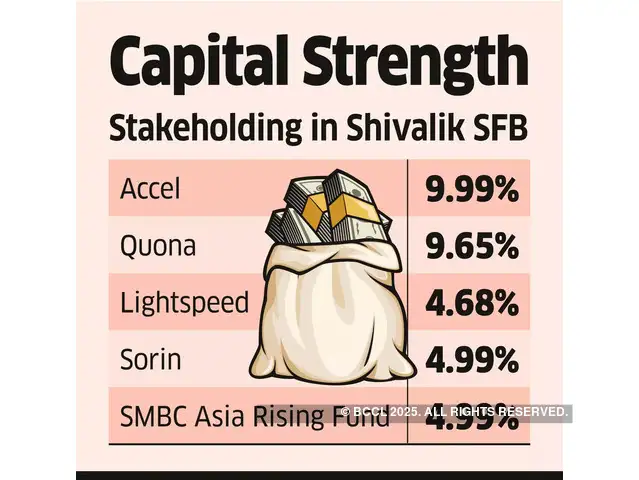
Kolkata: SMBC Asia Rising Fund, a corporate venture capital fund cofounded by Japan’s Sumitomo Mitsui Banking Corporation, has picked a 4.99% stake in Shivalik Small Finance Bank, the only small finance bank in India to have transformed from a cooperative entity. The fund has invested $7 million, or about ₹60 crore, for the stake, making the bank’s enterprise value around ₹1,200 crore, Shivalik managing director and chief executive officer Anshul Swami told ET.

The existing investors of Shivalik such as Accel, Quona, Lightspeed and Sorin Investments have also participated in this round, having put in another ₹40 crore between them on a pro-rata basis, taking the total equity raise to ₹100 crore. “The fresh equity will be used as growth capital,” Swami said. “We are building a strong digital foundation to serve the MSME and retail customers across Bharat.”

The funds will be utilised to strengthen the bank’s technology stack and expand its workforce across critical functions such as product, engineering, and operations, he said.

Rajeev Ranka, partner at SMBC Asia Rising Fund, said the fund seeks “partnerships with regulated entities that can enable our portfolio companies to collaborate and co-create products.” “Shivalik’s partner-first model aligns well with this objective,” he told ET.

This was the third equity raise by Shivalik since its transition into a bank. It had raised ₹100 crore in June last year from global venture capital firm Lightspeed and Sanjay Nayar-founded Sorin Investments along with participation from existing investors Accel India VII (Mauritius) and Quona Accion Inclusion Fund III. Accel and Quona first invested in the bank in FY22.

At present, institutional investors together have a 29.31% interest in the bank while the promoters hold around 40%. The balance is with retail investors, who are mostly old cooperative members. The bank is not listed on the stock exchanges.

The capital infusion will boost the bank’s capital adequacy ratio to 24% from 19% at present and support a 35-40% targeted business growth target this fiscal. The investment in Shivalik is SMBC Asia Rising Fund’s sixth in India.

The fund was cofounded by SMBC along with Incubate Fund of Singapore for the purpose of accelerating business development and partnerships through investments in high potential Asian startups.

Rajeev Kannan, managing executive officer and head of India division at SMBC, said the group is “committed to contributing to the broad-based growth of the Indian economy.”

Shivalik, an urban cooperative bank since 1997, got itself converted into a small finance bank in 2021. It has a retail banking legacy.

Now, it serves over 900,000 customers across 79 branches and 114 business correspondent outlets in 11 states. Its business size crossed ₹6,700 crore and manpower count rose to 1,000. It earned a revenue of ₹423 crore in FY25.

Besides organic expansion, Swami said, the bank management is open to acquisitions for faster growth.

“We are open to acquiring a small entity in the affordable housing finance space or in the secured MSME lending space,” he said. “People keep approaching us. But there is nothing concentre on the table at this point.”

Razorpay picks up majority stake in Pop for $30 million

Digital payments firm Razorpay invested $30 million (about Rs 259 crore) for a majority stake in consumer-facing payments startup Pop. The size of the stake wasn’t disclosed.

The Bengaluru-based startup, which focuses on UPI payments, had raised $12 million from Incubate Fund India and Unilever Ventures last October.

The investment gives Razorpay a foothold in consumer-internet business besides bolstering its play for direct-to-consumer (D2C) brands.

Cleantech asset financier StrideGreen raises $3.5 million from Micelio Tech Fund, Incubate Fund Asia

The Economic Times, covered our participation in Stride Green’s $3.5M seed round, where the company is building a tech-first platform for green asset financing and lifecycle management.

StrideGreen, a climate-tech focused asset financing and management platform, has raised $3.5 million in a funding round led by the clean mobility focused Micelio Technology Fund.

The round also saw early-stage venture capital firm Incubate Fund Asia participate.

The funds will be used to strengthen StrideGreen’s product offerings and expand its team.

“Largely, the deployment is focused on bringing expertise into the system. This could be in the form of talent, technology, or various new initiatives that we are currently exploring,” cofounder and chief executive Vivek Jain told ET. “The second aspect is creating bespoke solutions, which will require some capital commitments from our side.”

Read more at

Fintech startup Saswat Finance raises $2.6 million from Ankur Capital, others

Rural India-focussed fintech startup Saswat Finance has raised $2.6 million in a funding round led by early-stage investor Ankur Capital, with existing backer Incubate Fund Asia participating

The Mumbai-based startup will use the capital to expand its technology capabilities, roll out new financial products, scale operations across Maharashtra, Karnataka, and Uttar Pradesh, and strengthen its data and analytics infrastructure.

“The next big leap (for financing) is coming from the rural heartlands, and not from urban India, which is already highly penetrated,” cofounder Ravi Ranjan Chaudhary told ET. “But the biggest challenge in rural India is whether they have the understanding of finance, whether there is a reasonable amount of infrastructure available to reach there, and (whether) the customer is literate enough.”

Founded in 2022 by former bankers Arun Tiwari, Indrajyoti Bhattacharjee, and Chaudhary, Saswat aims to improve access to formal financial services in the rural economy, starting with the dairy supply sector.

“Thematically, we would be investing in structuring products, which are for the income-generating activities of the micro enterprises in the rural parts of India,” said Tiwari, its cofounder and CEO.

The company uses a data-driven approach to offer credit and insurance products tailored to smallholder farmers and rural enterprises. Saswat said its model is based on traditional and alternative data, from milk production and cash flows to weather and geography, to improve credit underwriting and enable faster delivery of financial products.

The startup said it has enabled the disbursal of over Rs 55 crore in asset-backed loans and onboarded more than 6,000 customers to date.

While Saswat currently offers cattle loans, insurance, and para-veterinary services, it is expanding into adjacent offerings for rural businesses.

The fintech company has built partnerships with dairy cooperatives, including Amul, Britannia, Nandini, and Hatsun; insurers such as Iffco Tokio General Insurance and Agriculture Insurance Company; and lenders such as RBL Bank and Shivalik Small Finance Bank, to strengthen its distribution and product offerings.

The funding comes at a time when fintech startups focussed on financial inclusion have been seeking greater government support through equity infusions to expand access to financial services in underserved areas and upgrade their tech infrastructure, particularly in rural India.

“With the ongoing digital transformation of the dairy sector and other large supply chains as a tailwind, Saswat is addressing a critical gap in the market by using their tech platform and leveraging alternative data to deliver substantial value at the last mile,” said Krishnan Neelakantan, partner at Ankur Capital.

Surat-Based B2B Textile Startup Fantail Secures INR 13.75 Cr Funding

Surat-based B2B textile manufacturing startup Fantail has raised INR 13.75 crore (approx USD 1.6 million) in a seed funding round led by Riverwalk Holdings, Incubate Fund Asia, and All In Capital.

The capital infusion will be deployed to empower partner SMEs in Surat, focusing on enhancing capabilities, upgrading processes and machinery, streamlining backend operations, and acquiring talent across design, quality, and technical roles.

Read more at

Chasing non-urban growth

Incubate Fund Asia founding partner Nao Murakami breaks down the firm’s fund thesis, target sectors, cheque sizes, and exit strategies — and why corporate governance matters more than ever

As global venture capital recalibrates in line with shifting macroeconomics, Incubate Fund Asia is doubling down on India’s underserved but rapidly rising middle-class, says founding partner Nao Murakami. With a third India-dedicated fund in deployment and a fourth on the horizon, the Singapore-headquartered fund is bullish on backing founders with the first institutional cheque, he says. Murakami breaks down the firm’s fund thesis, target sectors, cheque sizes, and exit strategies — and why corporate governance matters more than ever.

(Nao Murakami, Founding partner, Incubate Fund Asia)